World · permanent entity record · ML
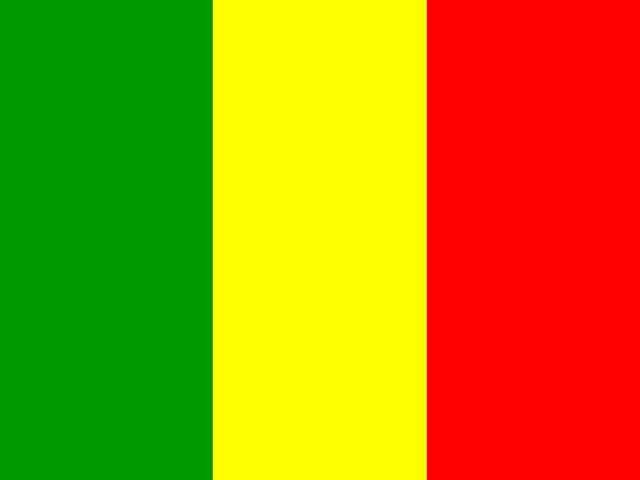
Mali
Thirty-second orientation
Mali at a glance
- Nationality / demonym
- noun: Malian(s); adjective: Malian
- CIA World Factbook final dataset, preserved by factbook.json · as of 2026-02-04
- Government
- semi-presidential republic
- CIA World Factbook final dataset, preserved by factbook.json · as of 2026-02-04
- Languages
- Bambara (official), French 17.2%, Peuhl/Foulfoulbe/Fulani 9.4%, Dogon 7.2%, Maraka/Soninke 6.4%, Malinke 5.6%, Sonrhai/Djerma 5.6%, Minianka 4.3%, Tamacheq 3.5%, Senoufo 2.6%, Bobo 2.1%, other 6.3%, unspecified 0.7% (2009 est.)
- CIA World Factbook final dataset, preserved by factbook.json · as of 2026-02-04
Independently structured milestones · not a complete national history
Mali through time
Admitted to the United Nations
Mali became a member of the United Nations.
United Nations, Member States · source checked 2026-09-04
Source history · changed fields only
Changes since the final CIA profile
| Field | Maintained Almanac value | Final CIA profile |
|---|---|---|
| Population | 25,198,821World Bank, World Development Indicators · observation year 2025 | total: 22,634,423 (2025 est.) male: 10,999,331 female: 11,635,092CIA World Factbook · as of 2026-01-18 |
A difference may reflect a newer observation, a revised estimate, or a different source definition. This table reports the values and dates; it does not manufacture a trend.
World Development Indicators · latest available observation
People, economy, and access
Observation years vary by measure. Each row identifies the series and year instead of presenting unlike dates as one current snapshot.
- Gross domestic product
- $30.1 billion
- World Bank, World Development Indicators · indicator NY.GDP.MKTP.CD · observation year 2025 · dataset updated 2026-07-13World Development Indicators observation for 2025; indicator NY.GDP.MKTP.CD. Underlying providers: National statistical authorities, central banks, OECD national accounts, and World Bank staff estimates. Retrieved 2026-09-08.
- Gross domestic product per person
- $1,193
- World Bank, World Development Indicators · indicator NY.GDP.PCAP.CD · observation year 2025 · dataset updated 2026-07-13World Development Indicators observation for 2025; indicator NY.GDP.PCAP.CD. Underlying providers: National statistical authorities, central banks, OECD national accounts, and World Bank staff estimates. Retrieved 2026-09-08.
- Life expectancy at birth
- 60.7 years
- World Bank, World Development Indicators · indicator SP.DYN.LE00.IN · observation year 2024 · dataset updated 2026-07-13World Development Indicators observation for 2024; indicator SP.DYN.LE00.IN. Underlying providers: UN Population Division, national statistical offices, and Eurostat. Retrieved 2026-09-08.
- Urban population
- 32.2%
- World Bank, World Development Indicators · indicator SP.URB.TOTL.IN.ZS · observation year 2025 · dataset updated 2026-07-13World Development Indicators observation for 2025; indicator SP.URB.TOTL.IN.ZS. Underlying providers: UN Population Division, World Urbanization Prospects. Retrieved 2026-09-08.
- Access to electricity
- 49.5%
- World Bank, World Development Indicators · indicator EG.ELC.ACCS.ZS · observation year 2024 · dataset updated 2026-07-13World Development Indicators observation for 2024; indicator EG.ELC.ACCS.ZS. Underlying providers: World Bank ESMAP, Tracking SDG 7. Retrieved 2026-09-08.
- People using the internet
- 36.8%
- World Bank, World Development Indicators · indicator IT.NET.USER.ZS · observation year 2024 · dataset updated 2026-07-13World Development Indicators observation for 2024; indicator IT.NET.USER.ZS. Underlying providers: International Telecommunication Union. Retrieved 2026-09-08.
World Development Indicators data are provided under Creative Commons Attribution 4.0 International (CC BY 4.0). The linked indicator metadata identifies the underlying statistical providers.
Maintained profile
- Capital
- Bamako
- CIA World Factbook final dataset, preserved by factbook.json · The nation set and displayed federal short name follow the current State Department independent-states register, dated August 11, 2026.
- Area
- 1,240,192 sq km
- CIA World Factbook final dataset, preserved by factbook.json · Final CIA source data preserved by a community mirror after the Factbook was retired; the mirror is not the issuing authority.
- Population
- 25,198,821
- World Bank, World Development Indicators · World Development Indicators observation for 2025; indicator SP.POP.TOTL. Underlying providers: UN Population Division, national statistical offices, and Eurostat. Retrieved 2026-09-08.
- Currency
- Communaute Financiere Africaine francs (XOF)
- CIA World Factbook final dataset, preserved by factbook.json · Currency label extracted from the Factbook exchange-rate field.
- Languages
- Bambara (official), French 17.2%, Peuhl/Foulfoulbe/Fulani 9.4%, Dogon 7.2%, Maraka/Soninke 6.4%, Malinke 5.6%, Sonrhai/Djerma 5.6%, Minianka 4.3%, Tamacheq 3.5%, Senoufo 2.6%, Bobo 2.1%, other 6.3%, unspecified 0.7% (2009 est.)
- CIA World Factbook final dataset, preserved by factbook.json · Factbook language listing reproduced without inferring official status beyond the source wording.
- Nationality / demonym
- noun: Malian(s); adjective: Malian
- CIA World Factbook final dataset, preserved by factbook.json · The source’s noun and adjective forms are retained. These are language labels, not evidence of any individual person’s citizenship.
- Continent
- Africa
- CIA World Factbook historical record · final public snapshot · Continental label standardized from the archived profile region “Africa.”
- Coastline
- 0 km (landlocked)
- CIA World Factbook historical record · final public snapshot · Preserved final CIA profile; this field is a historical baseline, not a claim of current conditions.
- Climate
- subtropical to arid; hot and dry (February to June); rainy, humid, and mild (June to November); cool and dry (November to February)
- CIA World Factbook historical record · final public snapshot · Preserved final CIA profile; this field is a historical baseline, not a claim of current conditions.
- Religions
- Muslim 93.9%, Christian 2.8%, animist 0.7%, none 2.5% (2018 est.)
- CIA World Factbook historical record · final public snapshot · Preserved final CIA profile; this field is a historical baseline, not a claim of current conditions.
- Flag colors
- green, yellow, red
- CIA World Factbook historical record · final public snapshot · Colors extracted from the flag description in the preserved final CIA profile.
- National symbol
- Great Mosque of Djenne
- CIA World Factbook historical record · final public snapshot · Preserved final CIA profile; this field is a historical baseline, not a claim of current conditions.
- Highest point
- Hombori Tondo · 3,789 ft (1,155 m)
- CIA World Factbook historical record · final public snapshot · Preserved final CIA profile; this field is a historical baseline, not a claim of current conditions.
- Lowest point
- Senegal River · 75 ft (23 m)
- CIA World Factbook historical record · final public snapshot · Preserved final CIA profile; this field is a historical baseline, not a claim of current conditions.
- NATO membership
- Not a member
- NATO, What is NATO? · Membership status is reported from the organization's current member list as of the stated date.
- BRICS membership
- Not a member
- BRICS Brazil, About the BRICS · Membership status is reported from the organization's current member list as of the stated date.
Preserved public-domain record · not maintained current data
Final CIA World Factbook profile
This is the preserved historical baseline from the Factbook’s final public snapshot. It is presented as the CIA stated it, not as a current Standard American Almanac finding. Current, independently maintained facts appear above when available.
CIA World Factbook historical record · final public snapshot · profile updated · pinned source record · commit d81154954b8b
Introduction1 fields
- Background
- Present-day Mali is named after the Mali Empire that ruled the region between the 13th and 16th centuries. At its peak in the 14th century, it was the largest and wealthiest empire in West Africa and controlled an area about twice the size of modern-day France. Primarily a trading empire, Mali derived its wealth from gold and maintained several goldfields and trade routes in the Sahel. The empire also influenced West African culture through the spread of its language, laws, and customs, but by the 16th century, it had fragmented into mostly small chiefdoms. The Songhai Empire, previously a Mali dependency centered in Timbuktu, gained prominence in the 15th and 16th centuries. Under Songhai rule, Timbuktu became a large commercial center, well-known for its scholarship and religious teaching. Timbuktu remains a center of culture in West Africa today. In the late 16th century, the Songhai Empire fell to Moroccan invaders and disintegrated into independent sultanates and kingdoms. France, expanding from Senegal, seized control of the area in the 1890s and incorporated it into French West Africa as French Sudan. In 1960, French Sudan gained independence from France and became the Mali Federation. When Senegal withdrew after only a few months, the remaining area was renamed the Republic of Mali. Mali saw 31 years of dictatorship until 1991, when a military coup led by Amadou Toumani TOURE ousted the government, established a new constitution, and instituted a multi-party democracy. Alpha Oumar KONARE won Mali's first two democratic presidential elections in 1992 and 1997. In keeping with Mali's two-term constitutional limit, he stepped down in 2002 and was succeeded by Amadou Toumani TOURE, who won a second term in 2007. In 2012, rising ethnic tensions and an influx of fighters -- some linked to Al-Qa’ida -- from Libya led to a rebellion and military coup. Following the coup, rebels expelled the military from the country’s three northern regions, allowing terrorist organizations to develop strongholds in the area. With a 2013 French-led military intervention, the Malian government managed to retake most of the north. However, the government’s grasp in the region remains weak with local militias, terrorists, and insurgent groups competing for control. In 2015, the Malian Government and northern rebels signed an internationally mediated peace accord. Despite a 2017 target for implementation of the agreement, the signatories have made little progress. Terrorist groups were left out of the peace process, and terrorist attacks remain common. Ibrahim Boubacar KEITA won the Malian presidential elections in 2013 and 2018. Aside from security and logistic shortfalls, international observers deemed these elections credible. Terrorism, banditry, ethnic-based violence, and extra-judicial military killings plagued the country during KEITA’s second term. In 2020, the military arrested KEITA, his prime minister, and other senior members of the government and established a military junta called the National Committee for the Salvation of the People (CNSP). The junta then established a transition government and appointed Bah N’DAW, a retired army officer and former defense minister, as interim president and Colonel Assimi GOITA, the coup leader and chairman of the CNSP, as interim vice president. The transition government’s charter allowed it to rule for up to 18 months before calling a general election. In 2021, GOITA led a military takeover, arresting the interim president after a Cabinet shake-up removed GOITA’s key allies. GOITA was sworn in as transition president, and Choguel Kokalla MAIGA was sworn in as prime minister. In 2022, the Economic Community of West African States (ECOWAS) imposed sanctions on the transition government, and member states closed their borders with Mali after the transition government presented a five-year extension to the electoral calendar. The transition government and ECOWAS agreed to a new two-year timeline, which would have included presidential elections in February 2024, but the transition government postponed the elections indefinitely in September 2023 and withdrew from ECOWAS in January 2024.
- CIA World Factbook historical record · as of · source
Geography21 fields
- Location
- interior Western Africa, southwest of Algeria, north of Guinea, Cote d'Ivoire, and Burkina Faso, west of Niger
- CIA World Factbook historical record · as of · source
- Area
- total : 1,240,192 sq km land: 1,220,190 sq km water: 20,002 sq km
- CIA World Factbook historical record · as of · source
- Area - comparative
- slightly less than twice the size of Texas
- CIA World Factbook historical record · as of · source
- Land boundaries
- total: 7,908 km border countries (6): Algeria 1,359 km; Burkina Faso 1,325 km; Cote d'Ivoire 599 km; Guinea 1,062 km; Mauritania 2,236 km; Niger 838 km, Senegal 489 km
- CIA World Factbook historical record · as of · source
- Climate
- subtropical to arid; hot and dry (February to June); rainy, humid, and mild (June to November); cool and dry (November to February)
- CIA World Factbook historical record · as of · source
- Terrain
- mostly flat to rolling northern plains covered by sand; savanna in south, rugged hills in northeast
- CIA World Factbook historical record · as of · source
- Elevation
- highest point: Hombori Tondo 1,155 m lowest point: Senegal River 23 m mean elevation: 343 m
- CIA World Factbook historical record · as of · source
- Natural resources
- gold, phosphates, kaolin, salt, limestone, uranium, gypsum, granite, hydropower note: bauxite, iron ore, manganese, tin, and copper deposits are known but not exploited
- CIA World Factbook historical record · as of · source
- Land use
- agricultural land: 35.5% (2023 est.) arable land: 6.8% (2023 est.) permanent crops: 0.2% (2023 est.) permanent pasture: 28.4% (2023 est.) forest: 8.8% (2023 est.) other: 55.8% (2023 est.)
- CIA World Factbook historical record · as of · source
- Major lakes (area sq km)
- fresh water lake(s): Lac Faguibine - 590 sq km note - the Niger River is the only source of water for the lake; in recent years the lake is dry
- CIA World Factbook historical record · as of · source
- Major rivers (by length in km)
- Niger (shared with Guinea [s], Niger, and Nigeria [m]) - 4,200 km; Senegal (shared with Guinea [s], Senegal, and Mauritania [m]) - 1,641 km note: [s] after country name indicates river source; [m] after country name indicates river mouth
- CIA World Factbook historical record · as of · source
- Major watersheds (area sq km)
- Atlantic Ocean drainage: Niger (2,261,741 sq km), Senegal (456,397 sq km), Volta (410,991 sq km)
- CIA World Factbook historical record · as of · source
- Major aquifers
- Lullemeden-Irhazer Basin, Taodeni-Tanezrouft Basin
- CIA World Factbook historical record · as of · source
- Population distribution
- the overwhelming majority of the population lives in the southern half of the country, with greater density along the border with Burkina Faso, as shown in this population distribution map
- CIA World Factbook historical record · as of · source
- Natural hazards
- hot, dust-laden harmattan haze common during dry seasons; recurring droughts; occasional Niger River flooding
- CIA World Factbook historical record · as of · source
- Geography - note
- landlocked; divided into three natural zones: the southern, cultivated Sudanese; the central, semiarid Sahelian; and the northern, arid Saharan
- CIA World Factbook historical record · as of · source
People and Society36 fields
- Population
- total: 22,634,423 (2025 est.) male: 10,999,331 female: 11,635,092
- CIA World Factbook historical record · as of · source
- Ethnic groups
- Bambara 33.3%, Fulani (Peuhl) 13.3%, Sarakole/Soninke/Marka 9.8%, Senufo/Manianka 9.6%, Malinke 8.8%, Dogon 8.7%, Sonrai 5.9%, Bobo 2.1%, Tuareg/Bella 1.7%, other Malian 6%, from members of Economic Community of West Africa 0.4%, other 0.3% (2018 est.)
- CIA World Factbook historical record · as of · source
- Languages
- Bambara (official), French 17.2%, Peuhl/Foulfoulbe/Fulani 9.4%, Dogon 7.2%, Maraka/Soninke 6.4%, Malinke 5.6%, Sonrhai/Djerma 5.6%, Minianka 4.3%, Tamacheq 3.5%, Senoufo 2.6%, Bobo 2.1%, other 6.3%, unspecified 0.7% (2009 est.) note: Mali has 13 national languages in addition to its official language
- CIA World Factbook historical record · as of · source
- Religions
- Muslim 93.9%, Christian 2.8%, animist 0.7%, none 2.5% (2018 est.)
- CIA World Factbook historical record · as of · source
- Age structure
- 0-14 years: 46.8% (male 5,175,714/female 5,114,128) 15-64 years: 50.1% (male 5,178,742/female 5,842,456) 65 years and over: 3.1% (2024 est.) (male 334,299/female 345,268)
- CIA World Factbook historical record · as of · source
- Dependency ratios
- total dependency ratio: 98.5 (2025 est.) youth dependency ratio: 92.3 (2025 est.) elderly dependency ratio: 6.2 (2025 est.) potential support ratio: 16.2 (2025 est.)
- CIA World Factbook historical record · as of · source
- Median age
- total: 16.5 years (2025 est.) male: 15.7 years female: 17.1 years
- CIA World Factbook historical record · as of · source
- Birth rate
- 39.44 births/1,000 population (2025 est.)
- CIA World Factbook historical record · as of · source
- Death rate
- 7.87 deaths/1,000 population (2025 est.)
- CIA World Factbook historical record · as of · source
- Net migration rate
- -2.82 migrant(s)/1,000 population (2025 est.)
- CIA World Factbook historical record · as of · source
- Population distribution
- the overwhelming majority of the population lives in the southern half of the country, with greater density along the border with Burkina Faso, as shown in this population distribution map
- CIA World Factbook historical record · as of · source
- Urbanization
- urban population: 46.2% of total population (2023) rate of urbanization: 4.57% annual rate of change (2020-25 est.)
- CIA World Factbook historical record · as of · source
- Major urban areas - population
- 2.929 million BAMAKO (capital) (2023)
- CIA World Factbook historical record · as of · source
- Sex ratio
- at birth: 1.03 male(s)/female 0-14 years: 1.01 male(s)/female 15-64 years: 0.89 male(s)/female 65 years and over: 0.97 male(s)/female total population: 0.95 male(s)/female (2024 est.)
- CIA World Factbook historical record · as of · source
- Mother's mean age at first birth
- 19.2 years (2018 est.) note: data represents median age at first birth among women 20-49
- CIA World Factbook historical record · as of · source
- Maternal mortality ratio
- 367 deaths/100,000 live births (2023 est.)
- CIA World Factbook historical record · as of · source
- Infant mortality rate
- total: 55.8 deaths/1,000 live births (2025 est.) male: 62.6 deaths/1,000 live births female: 52 deaths/1,000 live births
- CIA World Factbook historical record · as of · source
- Life expectancy at birth
- total population: 63.2 years (2024 est.) male: 60.9 years female: 65.6 years
- CIA World Factbook historical record · as of · source
- Total fertility rate
- 5.26 children born/woman (2025 est.)
- CIA World Factbook historical record · as of · source
- Drinking water source
- urban: 94.7% of population (2022 est.) rural: 74.4% of population (2022 est.) total: 83.6% of population (2022 est.) urban: 5.3% of population (2022 est.) rural: 25.6% of population (2022 est.) total: 16.4% of population (2022 est.)
- CIA World Factbook historical record · as of · source
- Health expenditure
- 4.5% of GDP (2021) 5.7% of national budget (2022 est.)
- CIA World Factbook historical record · as of · source
- Physician density
- 0.19 physicians/1,000 population (2023)
- CIA World Factbook historical record · as of · source
- Hospital bed density
- 0.2 beds/1,000 population (2018 est.)
- CIA World Factbook historical record · as of · source
- Sanitation facility access
- urban: 88.6% of population (2022 est.) rural: 49.3% of population (2022 est.) total: 67.2% of population (2022 est.) urban: 11.4% of population (2022 est.) rural: 50.7% of population (2022 est.) total: 32.8% of population (2022 est.)
- CIA World Factbook historical record · as of · source
- Alcohol consumption per capita
- total: 0.6 liters of pure alcohol (2019 est.) beer: 0.09 liters of pure alcohol (2019 est.) wine: 0 liters of pure alcohol (2019 est.) spirits: 0.02 liters of pure alcohol (2019 est.) other alcohols: 0.49 liters of pure alcohol (2019 est.)
- CIA World Factbook historical record · as of · source
- Tobacco use
- total: 6.9% (2025 est.) male: 13.1% (2025 est.) female: 0.6% (2025 est.)
- CIA World Factbook historical record · as of · source
- Children under the age of 5 years underweight
- 15% (2024 est.)
- CIA World Factbook historical record · as of · source
- Currently married women (ages 15-49)
- 79.2% (2018 est.)
- CIA World Factbook historical record · as of · source
- Child marriage
- women married by age 15: 15.9% (2018) women married by age 18: 53.7% (2018) men married by age 18: 2.1% (2018)
- CIA World Factbook historical record · as of · source
- Education expenditure
- 4.2% of GDP (2023 est.) 17.8% national budget (2024 est.)
- CIA World Factbook historical record · as of · source
- Literacy
- total population: 35.5% (2018 est.) male: 46.2% (2018 est.) female: 25.7% (2018 est.)
- CIA World Factbook historical record · as of · source
- School life expectancy (primary to tertiary education)
- total: 7 years (2017 est.) male: 8 years (2017 est.) female: 6 years (2017 est.)
- CIA World Factbook historical record · as of · source
Environment10 fields
- Environmental issues
- deforestation; soil erosion; desertification; loss of pasture land; inadequate supplies of potable water
- CIA World Factbook historical record · as of · source
- International environmental agreements
- party to: Biodiversity, Climate Change, Climate Change-Kyoto Protocol, Climate Change-Paris Agreement, Comprehensive Nuclear Test Ban, Desertification, Endangered Species, Hazardous Wastes, Law of the Sea, Ozone Layer Protection, Tropical Timber 2006, Wetlands, Whaling signed, but not ratified: Nuclear Test Ban
- CIA World Factbook historical record · as of · source
- Climate
- subtropical to arid; hot and dry (February to June); rainy, humid, and mild (June to November); cool and dry (November to February)
- CIA World Factbook historical record · as of · source
- Land use
- agricultural land: 35.5% (2023 est.) arable land: 6.8% (2023 est.) permanent crops: 0.2% (2023 est.) permanent pasture: 28.4% (2023 est.) forest: 8.8% (2023 est.) other: 55.8% (2023 est.)
- CIA World Factbook historical record · as of · source
- Urbanization
- urban population: 46.2% of total population (2023) rate of urbanization: 4.57% annual rate of change (2020-25 est.)
- CIA World Factbook historical record · as of · source
- Carbon dioxide emissions
- 6.858 million metric tonnes of CO2 (2023 est.) from coal and metallurgical coke: 83 metric tonnes of CO2 (2023 est.) from petroleum and other liquids: 6.858 million metric tonnes of CO2 (2023 est.)
- CIA World Factbook historical record · as of · source
- Particulate matter emissions
- 48.5 micrograms per cubic meter (2019 est.)
- CIA World Factbook historical record · as of · source
- Waste and recycling
- municipal solid waste generated annually: 1.937 million tons (2024 est.) percent of municipal solid waste recycled: 10.4% (2022 est.)
- CIA World Factbook historical record · as of · source
- Total water withdrawal
- municipal: 107 million cubic meters (2022 est.) industrial: 4 million cubic meters (2022 est.) agricultural: 5.075 billion cubic meters (2022 est.)
- CIA World Factbook historical record · as of · source
- Total renewable water resources
- 120 billion cubic meters (2022 est.)
- CIA World Factbook historical record · as of · source
Government23 fields
- Country name
- conventional long form: Republic of Mali conventional short form: Mali local long form: République de Mali local short form: Mali former: French Sudan, Sudanese Republic, Mali Federation etymology: name derives from the Mali Empire of the 13th to 16th centuries A.D.; the Mali name may come from a local ethnic group, the Malinke, whose name is derived from the words ma, meaning "mother," and dink, meaning "child" -- a reference to the matrilinear descent of Malinke families
- CIA World Factbook historical record · as of · source
- Capital
- name: Bamako geographic coordinates: 12 39 N, 8 00 W time difference: UTC 0 (5 hours ahead of Washington, DC, during Standard Time) etymology: the origin of the name is unclear, but it comes from the Bambara language and can refer either to a crocodile or to a person's name
- CIA World Factbook historical record · as of · source
- Administrative divisions
- 19 regions (régions, singular - région), 1 district*; Bamako*, Bandiagara, Bougouni, Dioila, Douentza, Gao, Kayes, Kidal, Kita, Koulikoro, Koutiala, Menaka, Mopti, Nara, Nioro, San, Segou, Sikasso, Taoudenni, Tombouctou (Timbuktu)
- CIA World Factbook historical record · as of · source
- Legal system
- civil law system based on the French civil law model and influenced by customary law; Constitutional Court reviews legislative acts
- CIA World Factbook historical record · as of · source
- Constitution
- history: several previous; latest drafted 13 October 2022 and submitted to Transition President Assimi GOITA; final draft completed 1 March 2023; approved by referendum 18 June 2023; validated by Constitutional Court 22 July 2023
- CIA World Factbook historical record · as of · source
- International law organization participation
- has not submitted an ICJ jurisdiction declaration; accepts ICCt jurisdiction
- CIA World Factbook historical record · as of · source
- Citizenship
- citizenship by birth: no citizenship by descent only: at least one parent must be a citizen of Mali dual citizenship recognized: yes residency requirement for naturalization: 5 years
- CIA World Factbook historical record · as of · source
- Executive branch
- chief of state: Transition President Assimi GOITA (since 7 June 2021) head of government: Transition Prime Minister Abdoulaye MAIGA (since 22 November 2024) cabinet: Council of Ministers appointed by the prime minister election/appointment process: president directly elected by absolute-majority popular vote in 2 rounds, if needed, for a 5-year term (eligible for a second term); prime minister appointed by the president most recent election date: 29 July 2018, with runoff on 12 August 2018 election results: 2018: Ibrahim Boubacar KEITA reelected president in second round; percent of vote in first round - Ibrahim Boubacar KEITA (RPM) 41.7%, Soumaila CISSE (URD) 17.8%, other 40.5%; percent of vote in second round - Ibrahim Boubacar KEITA 67.2%, Soumaila CISSE 32.8% note: in 2022, the transition government adopted a charter allowing transition authorities to rule for up to 5 years; in July 2025, the military-appointed National Transitional Council (CNT) unanimously adopted a revised transitional charter that granted transitional president General Assimi GOITA a five-year presidential mandate, renewable indefinitely, following the earlier dissolution of all political parties in May
- CIA World Factbook historical record · as of · source
- Legislative branch
- legislature name: Transitional National Council (Conseil national de transition) legislative structure: unicameral chamber name: Transitional National Council (Conseil national de transition) number of seats: 147 (all appointed) electoral system: plurality/majority scope of elections: full renewal most recent election date: 12/5/2020 percentage of women in chamber: 30.1% expected date of next election: December 2030 note 1: the National Assembly was dissolved on 18 August 2020 after a military coup; the transitional government created a Transitional National Council (CNT) that acts as the transitional government's legislative body; a new constitution was ratified in July 2023 that expanded the military junta's powers, and no plans for legislative elections have been announced note 2: coup leaders appointed a president and vice president; the president then apportioned CNT seats to various groups and political parties
- CIA World Factbook historical record · as of · source
- Judicial branch
- highest court(s): Supreme Court or Cour Suprême (consists of 19 judges organized into judicial, administrative, and accounting sections); Constitutional Court (consists of 9 judges) judge selection and term of office: Supreme Court judges appointed by the Ministry of Justice to serve 5-year terms; Constitutional Court judges selected - 3 each by the president, the National Assembly, and the Supreme Council of the Magistracy; members serve single renewable 7-year terms subordinate courts: Court of Appeal; High Court of Justice (jurisdiction limited to cases of high treason or criminal offenses by the president or ministers while in office); administrative courts (first instance and appeal); commercial courts; magistrate courts; labor courts; juvenile courts; special court of state security
- CIA World Factbook historical record · as of · source
- Political parties
- African Solidarity for Democracy and Independence or SADI Alliance for Democracy and Progress or ADP-Maliba Alliance for Democracy in Mali-Pan-African Party for Liberty, Solidarity, and Justice or ADEMA-PASJ Alliance for the Solidarity of Mali-Convergence of Patriotic Forces or ASMA-CFP Convergence for the Development of Mali or CODEM Democratic Alliance for Peace or ADP-Maliba Movement for Mali or MPM Party for National Renewal (also Rebirth or Renaissance or PARENA) Rally for Mali or RPM Social Democratic Convention or CDS Union for Democracy and Development or UDD Union for Republic and Democracy or URD Yéléma note 1: only parties with 2 or more seats in the last National Assembly parliamentary elections (30 March and 19 April 2020) included note 2: the National Assembly was dissolved on 18 August 2020 following a military coup and replaced with a National Transition Council; currently 121 members, party affiliations unknown
- CIA World Factbook historical record · as of · source
- Diplomatic representation in the US
- chief of mission: Ambassador Sékou BERTHE (since 16 September 2022) chancery: 2130 R Street NW, Washington, DC 20008 telephone: [1] (202) 332-2249 FAX: [1] (202) 332-6603 email address and website: administration@maliembassy.us https://www.maliembassy.us/
- CIA World Factbook historical record · as of · source
- Diplomatic representation from the US
- chief of mission: Ambassador Rachna KORHONEN (since 16 March 2023) embassy: ACI 2000, Rue 243, (located off the Roi Bin Fahad Aziz Bridge west of the Bamako central district), Porte 297, Bamako mailing address: 2050 Bamako Place, Washington DC 20521-2050 telephone: [223] 20-70-23-00 FAX: [223] 20-70-24-79 email address and website: ACSBamako@state.gov https://ml.usembassy.gov/
- CIA World Factbook historical record · as of · source
- International organization participation
- ACP, AfDB, AU (suspended), CD, EITI (compliant country), FAO, FZ, G-77, IAEA, IBRD, ICAO, ICCt, ICRM, IDA, IDB, IFAD, IFC, IFRCS, ILO, IMF, Interpol, IOC, IOM, IPU, ISO, ITSO, ITU, ITUC (NGOs), MIGA, MINUSCA, MONUSCO, NAM, OIC, OPCW, UN, UNCTAD, UNDP, UNESCO, UNFPA, UNHCR, UNIDO, UNOPS, UN Women, UNWTO, UPU, WADB (regional), WAEMU, World Bank Group, WCO, WFTU (NGOs), WHO, WIPO, WMO, WTO
- CIA World Factbook historical record · as of · source
- National holiday
- Independence Day, 22 September (1960)
- CIA World Factbook historical record · as of · source
- Flag
- description: three equal vertical bands of green (left side), yellow, and red history: uses the colors of the Pan-African movement note: the colors from left to right are the same as those of neighboring Senegal (which has an additional green central star) and the reverse of the flag of neighboring Guinea
- CIA World Factbook historical record · as of · source
- National anthem(s)
- title: "Le Mali" (Mali) lyrics/music: Seydou Badian KOUYATE/Banzoumana SISSOKO history: adopted 1962
- CIA World Factbook historical record · as of · source
- National heritage
- total World Heritage Sites: 4 (3 cultural, 1 mixed) selected World Heritage Site locales: Old Towns of Djenné (c); Timbuktu (c); Cliff of Bandiagara (Land of the Dogons) (m); Tomb of Askia (c)
- CIA World Factbook historical record · as of · source
Economy30 fields
- Economic overview
- low-income Saharan economy; recession due to COVID-19 and political instability; extreme poverty; environmentally fragile; high public debt; agricultural and gold exporter; terrorism and warfare are common
- CIA World Factbook historical record · as of · source
- Real GDP (purchasing power parity)
- $71.253 billion (2024 est.) $67.857 billion (2023 est.) $64.8 billion (2022 est.) note: data in 2021 dollars
- CIA World Factbook historical record · as of · source
- Real GDP growth rate
- 5% (2024 est.) 4.7% (2023 est.) 3.5% (2022 est.) note: annual GDP % growth based on constant local currency
- CIA World Factbook historical record · as of · source
- Real GDP per capita
- $2,900 (2024 est.) $2,900 (2023 est.) $2,800 (2022 est.) note: data in 2021 dollars
- CIA World Factbook historical record · as of · source
- GDP (official exchange rate)
- $26.588 billion (2024 est.) note: data in current dollars at official exchange rate
- CIA World Factbook historical record · as of · source
- Inflation rate (consumer prices)
- 3.2% (2024 est.) 2.1% (2023 est.) 9.6% (2022 est.) note: annual % change based on consumer prices
- CIA World Factbook historical record · as of · source
- GDP - composition, by sector of origin
- agriculture: 33.4% (2024 est.) industry: 22.7% (2024 est.) services: 36.7% (2024 est.) note: figures may not total 100% due to non-allocated consumption not captured in sector-reported data
- CIA World Factbook historical record · as of · source
- GDP - composition, by end use
- household consumption: 71.9% (2024 est.) government consumption: 13.1% (2024 est.) investment in fixed capital: 21.6% (2024 est.) investment in inventories: -0.7% (2024 est.) exports of goods and services: 22.5% (2024 est.) imports of goods and services: -28.4% (2024 est.) note: figures may not total 100% due to rounding or gaps in data collection
- CIA World Factbook historical record · as of · source
- Agricultural products
- maize, rice, millet, sorghum, onions, okra, sugarcane, cotton, mangoes/guavas, sweet potatoes (2023) note: top ten agricultural products based on tonnage
- CIA World Factbook historical record · as of · source
- Industries
- food processing; construction; phosphate and gold mining
- CIA World Factbook historical record · as of · source
- Industrial production growth rate
- -2.4% (2024 est.) note: annual % change in industrial value added based on constant local currency
- CIA World Factbook historical record · as of · source
- Labor force
- 9.126 million (2024 est.) note: number of people ages 15 or older who are employed or seeking work
- CIA World Factbook historical record · as of · source
- Unemployment rate
- 3.1% (2024 est.) 3% (2023 est.) 2.4% (2022 est.) note: % of labor force seeking employment
- CIA World Factbook historical record · as of · source
- Youth unemployment rate (ages 15-24)
- total: 4% (2024 est.) male: 4% (2024 est.) female: 3.9% (2024 est.) note: % of labor force ages 15-24 seeking employment
- CIA World Factbook historical record · as of · source
- Population below poverty line
- 44.6% (2021 est.) note: % of population with income below national poverty line
- CIA World Factbook historical record · as of · source
- Gini Index coefficient - distribution of family income
- 35.7 (2021 est.) note: index (0-100) of income distribution; higher values represent greater inequality
- CIA World Factbook historical record · as of · source
- Household income or consumption by percentage share
- lowest 10%: 3.2% (2021 est.) highest 10%: 28.3% (2021 est.) note: % share of income accruing to lowest and highest 10% of population
- CIA World Factbook historical record · as of · source
- Remittances
- 4.2% of GDP (2023 est.) 4.9% of GDP (2022 est.) 4.9% of GDP (2021 est.) note: personal transfers and compensation between resident and non-resident individuals/households/entities
- CIA World Factbook historical record · as of · source
- Budget
- revenues: $2.841 billion (2020 est.) expenditures: $3.563 billion (2020 est.) note: central government revenues and expenses (excluding grants/extrabudgetary units/social security funds) converted to US dollars at average official exchange rate for year indicated
- CIA World Factbook historical record · as of · source
- Taxes and other revenues
- 12% (of GDP) (2020 est.) note: central government tax revenue as a % of GDP
- CIA World Factbook historical record · as of · source
- Current account balance
- -$1.61 billion (2023 est.) -$1.475 billion (2022 est.) -$1.469 billion (2021 est.) note: balance of payments - net trade and primary/secondary income in current dollars
- CIA World Factbook historical record · as of · source
- Exports
- $6.13 billion (2023 est.) $5.855 billion (2022 est.) $5.381 billion (2021 est.) note: balance of payments - exports of goods and services in current dollars
- CIA World Factbook historical record · as of · source
- Exports - partners
- UAE 73%, Switzerland 15%, Australia 5%, China 1%, Uganda 1% (2023) note: top five export partners based on percentage share of exports
- CIA World Factbook historical record · as of · source
- Exports - commodities
- gold, cotton, oil seeds, fertilizers, gum resins (2023) note: top five export commodities based on value in dollars
- CIA World Factbook historical record · as of · source
- Imports
- $8.066 billion (2023 est.) $7.942 billion (2022 est.) $7.596 billion (2021 est.) note: balance of payments - imports of goods and services in current dollars
- CIA World Factbook historical record · as of · source
- Imports - partners
- Cote d'Ivoire 25%, Senegal 19%, China 12%, France 5%, Burkina Faso 4% (2023) note: top five import partners based on percentage share of imports
- CIA World Factbook historical record · as of · source
- Imports - commodities
- refined petroleum, broadcasting equipment, cement, cotton fabric, plastic products (2023) note: top five import commodities based on value in dollars
- CIA World Factbook historical record · as of · source
- Debt - external
- $4.085 billion (2023 est.) note: present value of external debt in current US dollars
- CIA World Factbook historical record · as of · source
- Exchange rates
- Communaute Financiere Africaine francs (XOF) per US dollar - 606.345 (2024 est.) 606.57 (2023 est.) 623.76 (2022 est.) 554.531 (2021 est.) 575.586 (2020 est.)
- CIA World Factbook historical record · as of · source
Energy6 fields
- Electricity access
- electrification - total population: 53% (2022 est.) electrification - urban areas: 99.7% electrification - rural areas: 18.3%
- CIA World Factbook historical record · as of · source
- Electricity
- installed generating capacity: 1.222 million kW (2023 est.) consumption: 4.261 billion kWh (2023 est.) exports: 661.63 million kWh (2023 est.) imports: 880 million kWh (2023 est.) transmission/distribution losses: 320.616 million kWh (2023 est.)
- CIA World Factbook historical record · as of · source
- Electricity generation sources
- fossil fuels: 57.3% of total installed capacity (2023 est.) solar: 3.5% of total installed capacity (2023 est.) hydroelectricity: 37.6% of total installed capacity (2023 est.) biomass and waste: 1.6% of total installed capacity (2023 est.)
- CIA World Factbook historical record · as of · source
- Petroleum
- refined petroleum consumption: 46,000 bbl/day (2023 est.)
- CIA World Factbook historical record · as of · source
- Energy consumption per capita
- 4.307 million Btu/person (2023 est.)
- CIA World Factbook historical record · as of · source
Communications6 fields
- Telephones - fixed lines
- total subscriptions: 307,000 (2022 est.) subscriptions per 100 inhabitants: 1 (2022 est.)
- CIA World Factbook historical record · as of · source
- Telephones - mobile cellular
- total subscriptions: 25.9 million (2022 est.) subscriptions per 100 inhabitants: 112 (2022 est.)
- CIA World Factbook historical record · as of · source
- Broadcast media
- national public TV broadcaster; 2 privately owned companies provide subscription services to foreign multi-channel TV packages; national public radio broadcaster supplemented by a large number of privately owned and community broadcast stations; transmissions of multiple international broadcasters are available (2019)
- CIA World Factbook historical record · as of · source
- Internet users
- percent of population: 35% (2023 est.)
- CIA World Factbook historical record · as of · source
- Broadband - fixed subscriptions
- total: 179,000 (2022 est.) subscriptions per 100 inhabitants: 1 (2022 est.)
- CIA World Factbook historical record · as of · source
Transportation4 fields
Military and Security6 fields
- Military and security forces
- Malian Armed Forces (Forces Armées Maliennes or FAMa): Army (l’Armée de Terre), Air Force (l’Armée de l’Air); National Guard (la Garde Nationale du Mali); National Gendarmerie of Mali (Gendarmerie Nationale du Mali) (2025) note 1: the Gendarmerie and the National Guard are under the authority of the Ministry of Defense and Veterans Affairs (Ministere De La Defense Et Des Anciens Combattants, MDAC), but operational control is shared with the Ministry of Internal Security and Civil Protection which also controls the National Police; the National Police has responsibility for law enforcement and maintenance of order in urban areas and supports the FAMa in internal military operations note 2: the Gendarmerie's primary mission is internal security and public order; its duties also include territorial defense, humanitarian operations, intelligence gathering, and protecting private property, mainly in rural areas; it also has a specialized border security unit note 3: the National Guard is a military force responsible for providing security to government facilities and institutions, prison service, public order, humanitarian operations, some border security, and intelligence gathering; its forces include a camel corps for patrolling the deserts and borders of northern Mali note 4: there are also pro-government militias operating in Mali, such as the Imghad Tuareg Self-Defense Group and Allies (GATIA); the leader of GATIA is also a general in the national army
- CIA World Factbook historical record · as of · source
- Military expenditures
- 4.3% of GDP (2024 est.) 4% of GDP (2023 est.) 3.5% of GDP (2022 est.) 3.4% of GDP (2021 est.) 3.4% of GDP (2020 est.)
- CIA World Factbook historical record · as of · source
- Military and security service personnel strengths
- information varies; estimated 35-40,000 active FAMa, Gendarmerie, and National Guard (2025)
- CIA World Factbook historical record · as of · source
- Military equipment inventories and acquisitions
- the FAMa's inventory includes mostly Soviet-era weapons and equipment along with smaller quantities of more modern material from a variety of suppliers, including France, Russia, South Africa, Türkiye, and the UAE (2025)
- CIA World Factbook historical record · as of · source
- Military service age and obligation
- 18 years of age for men and women for selective compulsory and voluntary military service; 24-month compulsory service obligation (2025)
- CIA World Factbook historical record · as of · source
- Military - note
- the FAMa is responsible for the defense of the country’s sovereignty and territory, but also has some domestic security duties, including the maintenance of public order and support to law enforcement; it also participates in socio-economic development projects; the military has traditionally played a large role in Mali’s politics; prior to the coup in August 2020 and military takeover in May 2021, it had intervened in the political arena at least five times since the country gained independence in 1960 (1968, 1976, 1978, 1991, 2012) the FAMa and other security forces are actively engaged in combat operations against several insurgent/terrorist groups affiliated with al-Qa'ida and the Islamic State of Iraq and ash-Sham (ISIS), as well as other armed rebel organizations, communal militias, and criminal bands spread across the central, northern, and southern regions of the country; a large portion of the country--up to 50% by some estimates--is outside of government control the FAMa and the remainder of the security forces collapsed in 2012 during the fighting against Tuareg rebels and Islamic militants and were rebuilt beginning in 2013 with external assistance from the EU and the UN; the UN Multidimensional Integrated Stabilization Mission in Mali (MINUSMA) and the EU Training Mission in Mali (EUTM) ended their missions in 2023 and 2024, respectively; France intervened militarily in Mali in 2013 to assist with regaining the northern half of the country from rebel and Islamic militant groups; French troops withdrew in 2022; since 2021, Mali has increased security ties with Russia, which has provided equipment, training, and other forms of military support (2025)
- CIA World Factbook historical record · as of · source
Terrorism1 fields
- Terrorist group(s)
- Ansar al-Dine; Islamic State of Iraq and ash-Sham in the Greater Sahara (ISIS-GS); Jama'at Nusrat al-Islam wal-Muslimin (JNIM); al-Mulathamun Battalion (al-Mourabitoun) note: details about the history, aims, leadership, organization, areas of operation, tactics, targets, weapons, size, and sources of support of the group(s) appear(s) in the Terrorism reference guide
- CIA World Factbook historical record · as of · source
Transnational Issues1 fields
- Refugees and internally displaced persons
- refugees: 135,827 (2024 est.) IDPs: 378,363 (2024 est.)
- CIA World Factbook historical record · as of · source
The underlying United States government material is public domain. The Almanac’s reuse terms do not change the legal status of this preserved source layer.